
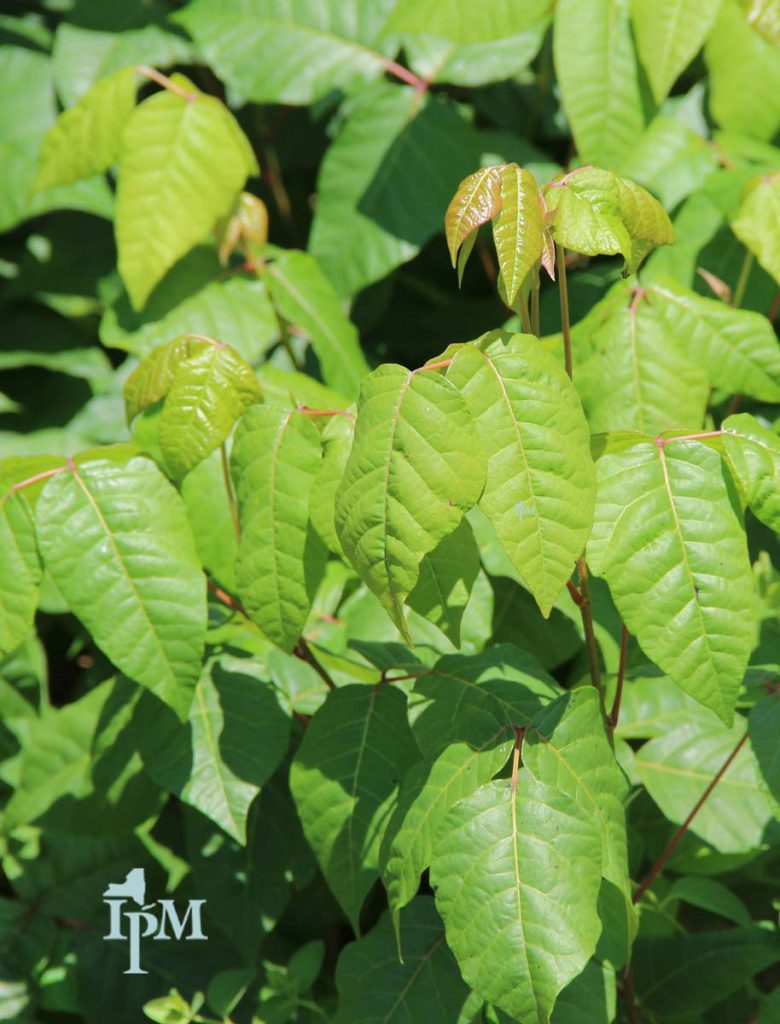
Poison Ivy
The deciduous leaves of poison ivy are trifoliate with three almond-shaped leaflets. Leaf color ranges from light green (usually the younger leaves) to dark green (mature leaves), turning bright red in fall; though other sources say leaves are reddish when expanding, turn green through maturity, then back to red, orange, or yellow in the fall. The leaflets of mature leaves are somewhat shiny. The leaflets are 3 to 12 cm long, rarely up to 30 cm. Each leaflet has a few or no teeth along its edge, and the leaf surface is smooth. Leaflet clusters are alternate on the vine, and the plant has no thorns. Vines growing on the trunk of a tree become firmly attached through numerous aerial rootlets. The vines develop adventitious roots, or the plant can spread from rhizomes or root crowns. The milky sap of poison ivy darkens after exposure to the air.rPoison ivy spreads either vegetatively or sexually. Poison ivy is dioecious; flowering occurs from May to July. The yellowish- or greenish-white flowers are typically inconspicuous and are located in clusters up to 8 cm above the leaves. The berry-like fruit, a drupe, mature by August to November with a grayish-white color. Fruits are a favorite winter food of some birds and other animals. Seeds are spread mainly by animals and remain viable after passing through the digestive tract.
Bonide Solutions
-
 Chickweed, Clover & Oxalis Killer Concentrate
-
 Stump & Vine Killer Concentrate
-
 Weed Beater ULTRA Ready-to-Use
-
 Weed Beater Ultra Concentrate
-
 Poison Ivy & Brush Killer Bk-32 Concentrate
-
 Poison Oak & Ivy Killer RTU
-
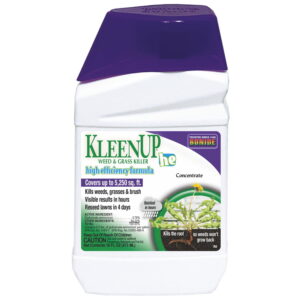 KleenUp “HE” High Efficiency Weed & Grass Killer Concentrate
-
 KleenUp “HE” High Efficiency Weed & Grass Killer RTU
-
 DuraTurf Weed & Feed